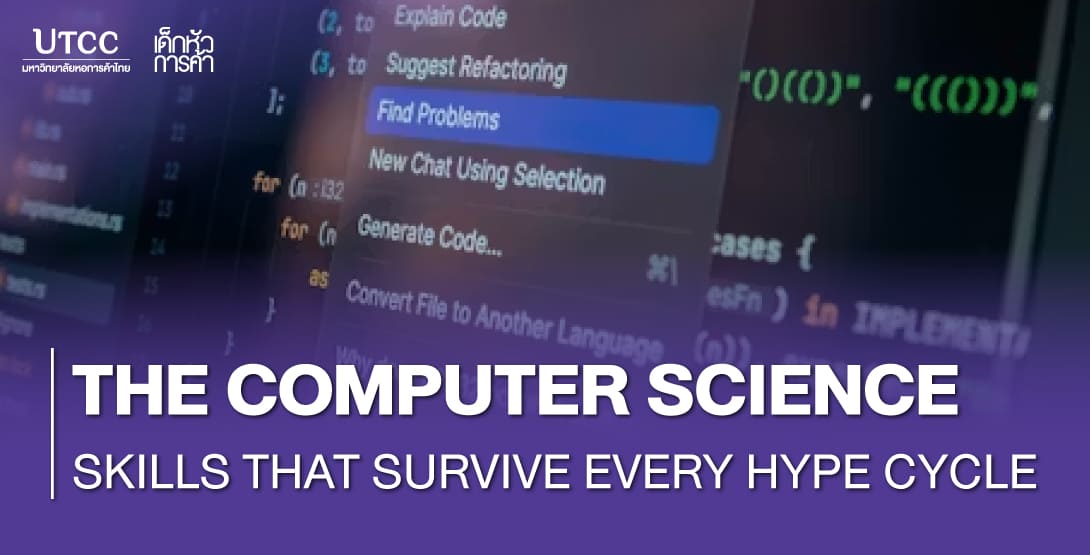
The Computer Science Skills That Survive Every Hype Cycle
Student blog — 21/08/2026
Computer Science Career Growth
Reading Time: 7 minutes
If you started a computer science degree three years ago, the technology landscape you planned for no longer exists. Frameworks you were told to learn have been replaced. Tools that seemed essential are now optional. The job descriptions have been rewritten twice.
This is not new, and it is not going to stop. The useful response is not to chase every shift, but to work out which skills keep their value across all of them. There are a handful, and they are less exciting than whatever is currently trending — which is exactly why fewer people invest in them properly.
This is not new, and it is not going to stop. The useful response is not to chase every shift, but to work out which skills keep their value across all of them. There are a handful, and they are less exciting than whatever is currently trending — which is exactly why fewer people invest in them properly.
Why Chasing Tools Is a Losing Strategy
Tool-specific knowledge depreciates fast. The half-life of a specific framework is short, and you are competing against thousands of people who watched the same tutorial. Meanwhile, the underlying skills that make someone effective in any tool depreciate slowly or not at all.
This does not mean ignore new tools. It means treat them as the surface layer, learned quickly when needed, on top of a foundation you build deliberately over years.
This does not mean ignore new tools. It means treat them as the surface layer, learned quickly when needed, on top of a foundation you build deliberately over years.
Six Skills That Keep Their Value
1. Reading code you did not write
Almost every professional task begins with understanding something someone else built, often badly documented and under deadline. Most students spend their entire degree writing code from scratch and never practise this.
It is a trainable skill. Pick an open-source project, choose one feature, and trace how it works end to end. Do it repeatedly and you will develop the ability to orient yourself in unfamiliar code quickly — which is roughly what your first month at any job consists of.
It is a trainable skill. Pick an open-source project, choose one feature, and trace how it works end to end. Do it repeatedly and you will develop the ability to orient yourself in unfamiliar code quickly — which is roughly what your first month at any job consists of.
2. Debugging as a systematic process
The difference between a strong and weak engineer shows up most clearly when something is broken and the cause is not obvious. Weak debugging is guessing and changing things. Strong debugging is forming a hypothesis, designing a test that would disprove it, and narrowing the space methodically.
This skill transfers to every language, every stack, and increasingly to working with AI-generated code — where you frequently receive something that looks correct and has to be verified rather than trusted.
This skill transfers to every language, every stack, and increasingly to working with AI-generated code — where you frequently receive something that looks correct and has to be verified rather than trusted.
3. Knowing what is actually expensive
Understanding why one approach is slow and another is fast — memory access, network calls, database queries, algorithmic complexity — is what separates code that works on your laptop from code that works at scale.
This knowledge outlives languages entirely. The specifics change, but the reasoning does not, and it is the basis for almost every meaningful architectural decision you will be asked to make.
This knowledge outlives languages entirely. The specifics change, but the reasoning does not, and it is the basis for almost every meaningful architectural decision you will be asked to make.
4. Writing so other people understand you
Engineers write constantly: commit messages, design documents, incident reports, code review comments, explanations for people who do not code. Clear writing gets your ideas adopted. Unclear writing means good ideas get ignored.
This is among the highest-leverage skills available to a student because so few people work on it deliberately, and because it compounds — every good document you write makes the next one easier.
This is among the highest-leverage skills available to a student because so few people work on it deliberately, and because it compounds — every good document you write makes the next one easier.
5. Designing systems, not just functions
Writing a correct function is a solved problem for most people by graduation. Deciding how components should communicate, where state should live, what happens when a dependency fails, and how the thing gets deployed and monitored — that is the work that defines seniority.
Start small. Take any project you have built and write down how it would break under ten times the load. That exercise teaches more system design than reading about it.
Start small. Take any project you have built and write down how it would break under ten times the load. That exercise teaches more system design than reading about it.
6. Judgement about when not to build
The most experienced engineers are notable for how much they decline to build. Recognising when a problem does not need a technical solution, when an existing tool is sufficient, or when the requirement is confused — that judgement saves more time than any productivity gain.
It is also the hardest to teach, because it comes mostly from having built the wrong thing a few times and paid attention afterwards.
It is also the hardest to teach, because it comes mostly from having built the wrong thing a few times and paid attention afterwards.
Where AI Fits Into This
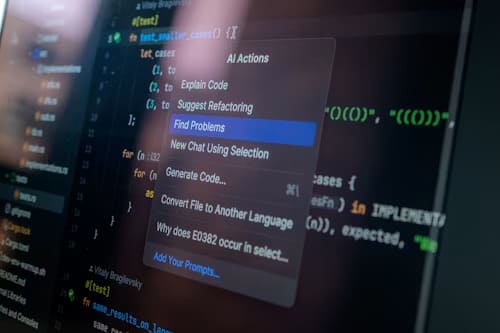
AI has made producing code dramatically faster. It has not made deciding what to build, verifying that it is correct, or understanding why it broke any easier. If anything, the volume of code that needs reviewing has gone up while the number of people who can review it well has not.
Thailand’s National AI Strategy and Action Plan for 2022–2027 includes substantial workforce development targets alongside infrastructure and adoption goals [dig.watch][oecd.ai]. At the same time, Thai businesses reached medium digital maturity for the first time in the Digital Outlook 2026 survey, with continuing weakness in digital product development and R&D [bangkokpost].
That gap between adoption and capability is where engineers with real fundamentals become valuable. Anyone can generate code now. Far fewer people can tell whether it should be trusted.
Thailand’s National AI Strategy and Action Plan for 2022–2027 includes substantial workforce development targets alongside infrastructure and adoption goals [dig.watch][oecd.ai]. At the same time, Thai businesses reached medium digital maturity for the first time in the Digital Outlook 2026 survey, with continuing weakness in digital product development and R&D [bangkokpost].
That gap between adoption and capability is where engineers with real fundamentals become valuable. Anyone can generate code now. Far fewer people can tell whether it should be trusted.
A Practical Way to Build These
Every week: read one piece of code you did not write and explain it to someone in three sentences.
Every month: take something you built and deliberately break it, then fix it without reverting.
Every project: write a short document before you start explaining what you are building and why, and a short one afterwards explaining what you got wrong.
Every time you use AI: review its output as though a stranger wrote it and you are responsible for the consequences. Because you are.
Every month: take something you built and deliberately break it, then fix it without reverting.
Every project: write a short document before you start explaining what you are building and why, and a short one afterwards explaining what you got wrong.
Every time you use AI: review its output as though a stranger wrote it and you are responsible for the consequences. Because you are.
The Bottom Line
The technologies you will use in ten years mostly do not exist yet. Optimising your education for today’s tool stack is a bet that the current moment is permanent, and it never has been.
Build the skills that transfer: reading, debugging, reasoning about cost, writing, system design, and judgement. They are less immediately impressive than a list of frameworks, and they are the reason some engineers stay valuable across three decades while others reset their career every time the industry moves.
Build the skills that transfer: reading, debugging, reasoning about cost, writing, system design, and judgement. They are less immediately impressive than a list of frameworks, and they are the reason some engineers stay valuable across three decades while others reset their career every time the industry moves.
Ready to Start?
Choose one open-source project this week and trace a single feature from the user interface to the database and back. Write down what you learned. That one exercise touches five of the six skills above.
Related resources:
- From Code to Product – Combining Tech and Business
- How Do You Stay Ahead of AI
- Upskilling and Reskilling Programmes
Tags:
#ComputerScience, #SoftwareEngineering, #CareerGrowth, #AI, #Debugging, #SystemDesign, #StudentSkills #harbourspacebkk
All Links Used in This Post
Tags:
External Links:
Share